
Creating with AI: When the Machine Becomes the Writer's Apprentice
The literary world is going through a period of turbulence. Faced with the emergence of artificial intelligence, a legitimate fear has taken hold: will the machine devour the artist? Will it standardize imagination and replace the soul of our novels with cold, predictable algorithms?
If we entrust AI with doing everything, the answer is probably yes. Literature would lose its essence. But writing a book is not a monolithic act; it's a complex process, made of flashes of brilliance, but above all of labor, doubts, and organization.
And it's precisely there, behind the scenes of creation, that artificial intelligence can become a tremendous tool. Not as a replacement, but as a devoted assistant in the exclusive service of the writer's vision. Here's how AI can integrate into the creative process without ever taking the human's place.
1. The Architect of Shadows: Structuring a Complex Universe
Anyone who has ever embarked on writing an epic saga—imagine a fresco spanning several dozen volumes—knows that worldbuilding can quickly become a dizzying labyrinth. Mapping kingdoms, forging political systems, establishing genealogies... the mental burden is colossal.
AI excels at structuring data. It can:
-
Create lore databases: Generate summary sheets for your characters, including their secret motivations, their speech patterns, and their narrative arcs.
-
Manage retcons and inconsistencies: You decided midway to modify your universe's history, for example by renaming an entire region so it becomes the lands of Ondeval? AI can analyze your notes to identify all the geopolitical and narrative repercussions of this change, thus sparing you gaping holes in your plot. The artist's role: You're the one who breathes life, atmosphere, and laws into this world. AI merely organizes the library you've built.
2. The Intellectual Ping-Pong Partner (Brainstorming)
Writer's block is often not a lack of ideas, but a traffic jam. You know your protagonists need to meet in a tavern to plan a betrayal, but you're stuck on the scene's trigger.
Rather than staring at your screen for hours, you can use AI as a brainstorming partner. By presenting your impasse to it, it will offer you ten solutions. Nine of them will probably be clichéd or off-point. But the tenth will spark something. Better yet: it's often by reading a bad AI suggestion that your brain, through creative contrariness, will find the right idea. The artist's role: Discernment. AI proposes raw ore; the writer chooses the nugget and cuts it.
3. The Ruthless Proofreader (Structural Revision)
Once the first draft is complete comes the often dreaded revision stage. AI will never replace the sensitivity of a human reader or a beta-reader, but it can act as a macroscopic corrector.
-
Rhythm analysis: It can spot if a chapter drags on too long or if the action is rushed.
-
Hunting for repetitions and verbal tics: It highlights your writing automatisms that you no longer see.
-
Readability test: It checks whether a complex combat scene is spatially comprehensible for someone who doesn't have the mental map of the room in their head.
The Red Line: What AI Must Never Do
For art to remain art, the boundary must be clear. AI must not write the prose. The dark poetry of a description, the raw emotion of a dialogue, the rhythmic cadence of a deadly confrontation, the melancholy of a farewell in the rain... All of this belongs to the writer's voice. It's the accumulation of your human experiences, your sorrows, your joys, and your worldview that gives a text its unique flavor. AI feels nothing. It only predicts the statistically most probable next word. Literature, conversely, feeds on the unpredictable, the flaw, and the human.
In Conclusion
Artificial intelligence is a hammer and an anvil. It's the forge's fire. But the writer remains the blacksmith. By delegating logistics, sorting, and organization to the machine, the artist frees themselves from a crushing burden. They thus gain precious time and mental clarity that they can reinvest where they are irreplaceable: in creating true emotion.
✦ Up next
Related articles
✦ The Saga awaits
Enjoyed this article?
Dive into the full universe of Aëtheria.
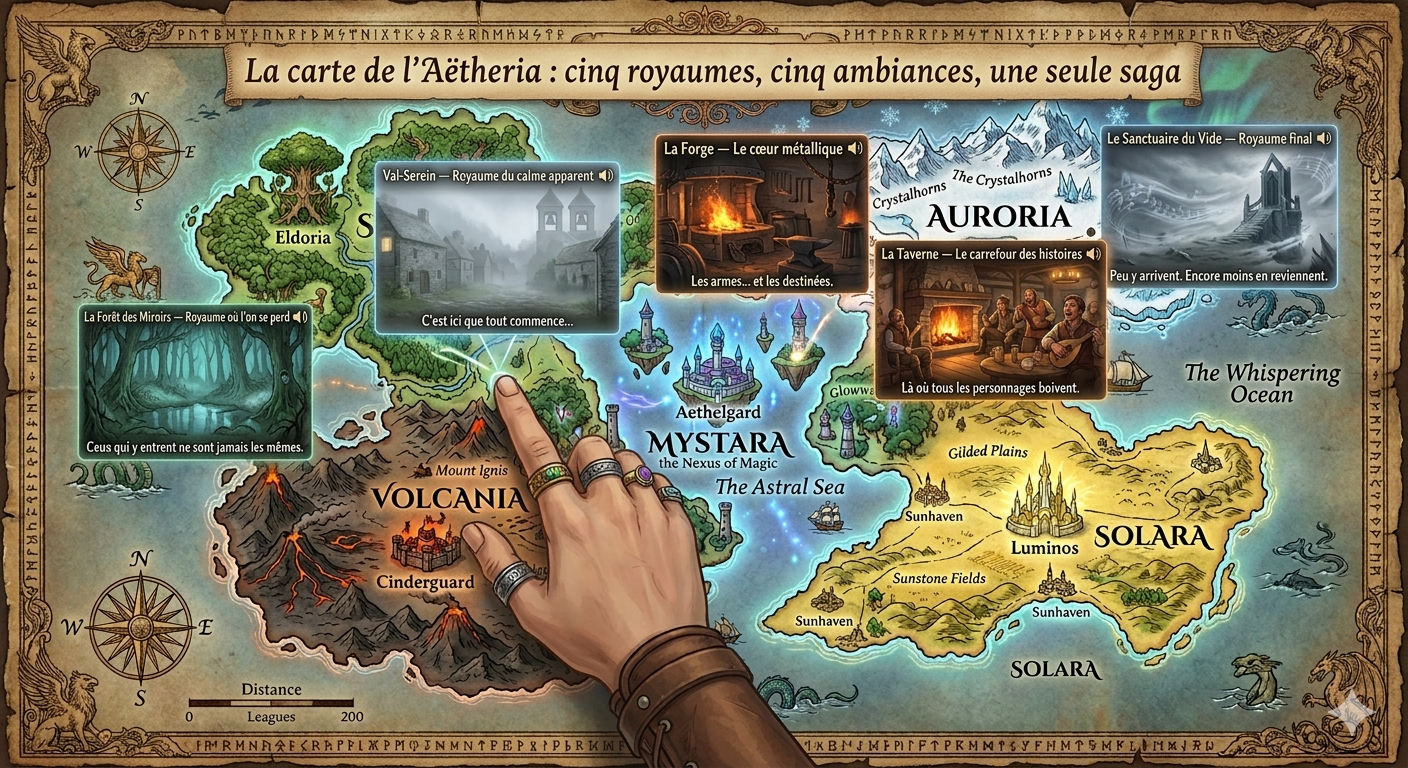
L'Écho du Vide is more than a blog. It's an immersive multi-book saga, an interactive map of the realm, a tavern where AI characters answer you, and cinematic audio on every chapter.
- ✦First chapter free — no card required
- ✦Full narrative audio on every chapter
- ✦Interactive map of Aëtheria
- ✦The Tavern — chat with the characters
No commitment. Cancel anytime. ← Back to the blog